OWASP SecretSifter
SecretSifter finds credentials exposed in what web applications actually deliver to the browser: JavaScript bundles, HTML, configuration and API responses.
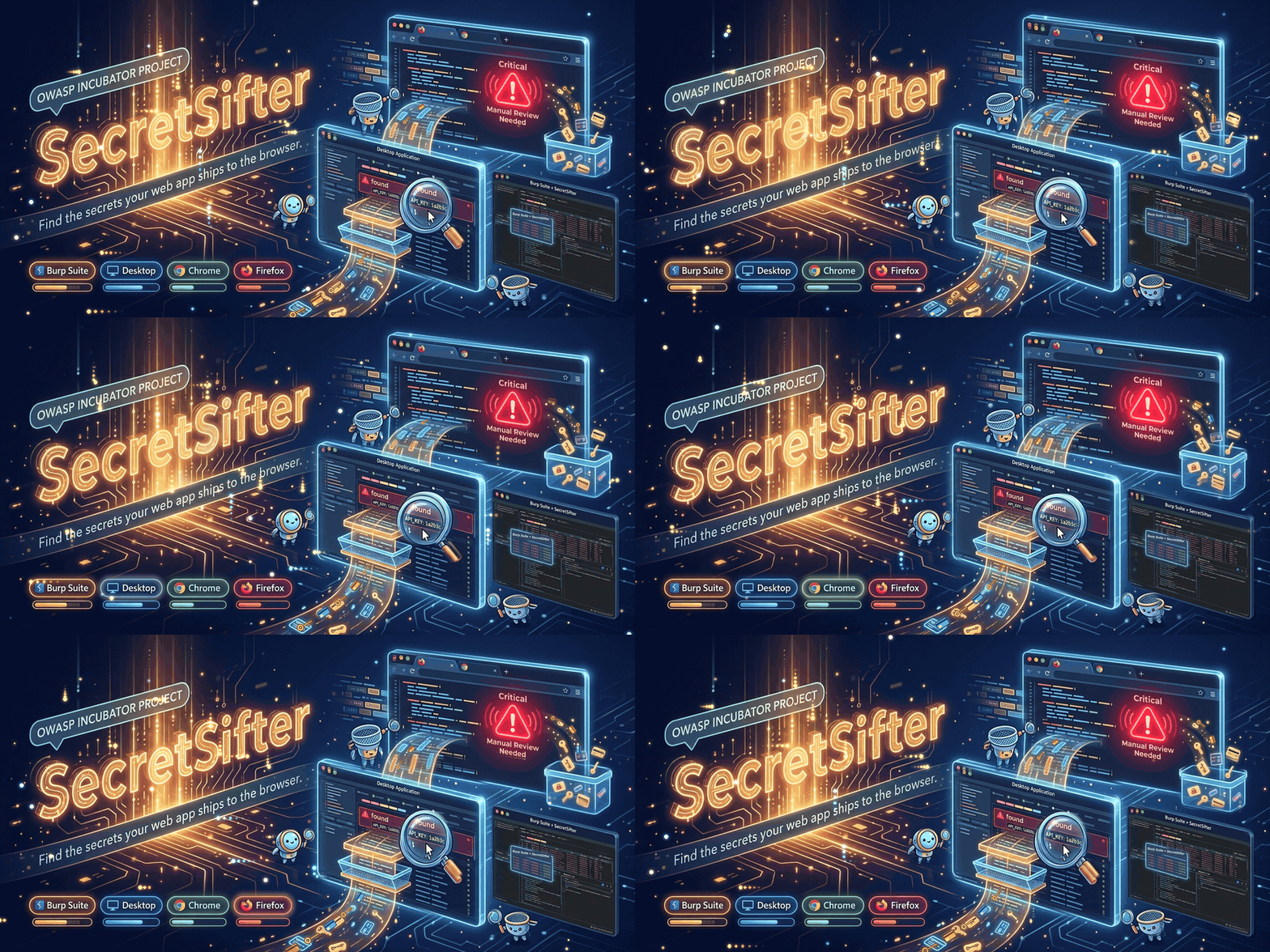
About OWASP SecretSifter
What it does
Pre-deployment secret scanning looks at source code, but some credentials are introduced at build time or by runtime configuration and never appear in the repository. SecretSifter inspects the content a client actually receives and reports each finding with its location and evidence for a tester to assess. It complements repository and CI scanning; it does not replace them.
Editions
Burp Suite extension: open source (MIT), source in burp-extension/
Burp MCP edition: the Burp extension plus optional AI triage and a local MCP server, open source (MIT), source in burp-mcp/
Browser extension for Chrome and Firefox: free release
Desktop app for Windows and macOS: free release
Publishing the browser extension and desktop app source under MIT is on the project roadmap.
Latest releases
Burp Suite extension v1.0.3, released October 14, 2026
Burp MCP edition v1.0.2, released October 14, 2026
Research
H. Gorijala, "Secrets That Survive Everything: Runtime Credential Exposure in Production Web Applications," IEEE Access, 2026. https://doi.org/10.1109/ACCESS.2026.3734984
H. Gorijala, "SecretSifter: A Runtime Secret-Detection Engine for Live Web Traffic," SoftwareX, vol. 36, 103087, 2026. https://doi.org/10.1016/j.softx.2026.103087
Get involved
Issues and pull requests are welcome, especially new detection rules with test cases.
Project Resources
Project Leaders
Hemanth Gorijala
Project Lead
Global Pentest Lead (AVP) and creator of SecretSifter. His research on credential exposure in browser-delivered content is published in IEEE Access and Elsevier SoftwareX, and he is the author of "Secrets in the Browser: Detecting and Remediating Client-Side Credential Exposure." Speaker at DEF CON 34 (Demo Labs and Red Team Village workshop), Black Hat India Arsenal, Blue Team Con, Carnegie Mellon University SEI, and BSides Buffalo, San Antonio and NYC.
Project Information
Requirements
- Burp Suite 2025.6 or later (Professional or Community)
- Java 17 or later to build from source

 Slack