OWASP Security Shepherd
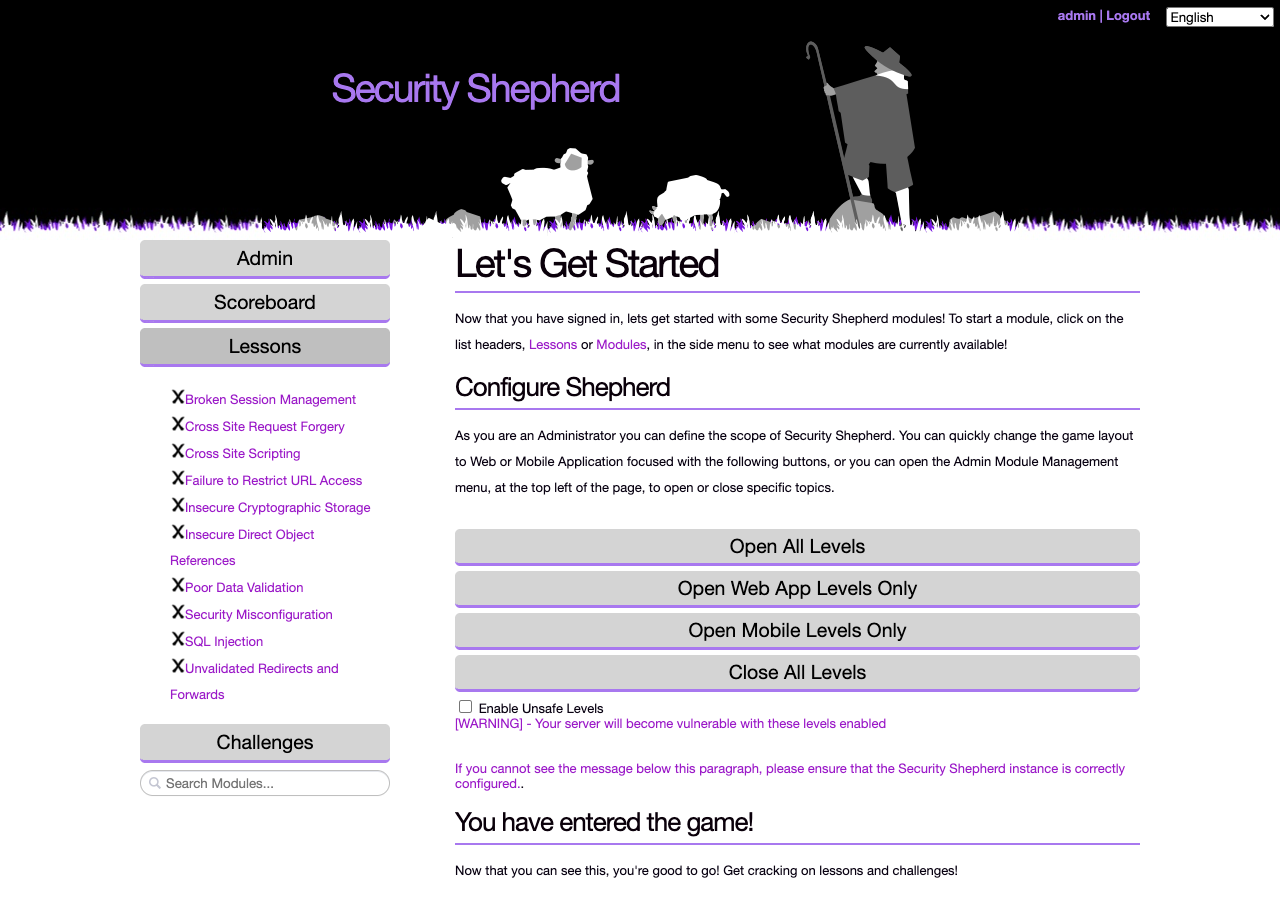
The start page after you log in as admin
Run Security Shepherd on your own machine with Docker in about 10 minutes. You need Git, JDK 17, Maven and Docker: clone the repository, build it with Maven, start it with Docker Compose, and log in as admin. Getting started, linked below, walks you through each step, including how to open the levels.
Shepherd is deliberately vulnerable, so run it on a machine or network used only for training.
The current release is 3.1, from 2018. Version 4.0, a full modernisation, is in development, and it's what these steps build. The Roadmap tab describes what's in it.
The OWASP Security Shepherd project enables users to learn or to improve upon existing manual penetration testing skills. This is accomplished by presenting security risk concepts to users in lessons followed by challenges. A lesson provides a user with help in layman terms about a specific security risk, and helps them exploit a text book version of the issue. Challenges include poor security mitigations to vulnerabilities which have left room for users to exploit.
Utilizing the OWASP top ten as a challenge test bed, common security vulnerabilities can be explored and their impact on a system understood. The by-product of this challenge game is the acquired skill to harden a player’s own environment from OWASP top ten security risks. The modules have been crafted to provide not only a challenge for a security novice, but security professionals as well.
Shepherd’s security risks are real vulnerabilities, not simulations, so any attack vector behaves as it would in the real world. Most levels are hardened so they can’t be used against the platform itself. The optional unsafe levels are not, so only open them on an isolated server.
Security Shepherd is highly configurable. System administrators can tune the project experience to present specific security risk topics or even specific Security Shepherd modules. The array of user and module configuration available allows Shepherd to be used by a single local user, by many in a competitive classroom environment or by hundreds in an online hacking competition.
Project Information
Requirements
- Docker with Docker Compose
- JDK 17 and Maven 3.9.2+ to build

 Slack