OAT-017 Spamming
Spamming is an automated threat. The OWASP Automated Threat Handbook - Web Applications (pdf, print), an output of the OWASP Automated Threats to Web Applications Project, provides a fuller guide to each threat, detection methods and countermeasures. The threat identification chart helps to correctly identify the automated threat.
Definition
OWASP Automated Threat (OAT) Identity Number
OAT-017
Threat Event Name
Spamming
Summary Defining Characteristics
Malicious or questionable information addition to public or private content, or messages.
Indicative Diagram
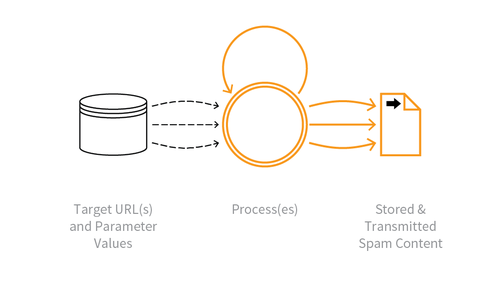
Description
Malicious content can include malware, IFRAME distribution, photographs & videos, advertisements, stolen intellectual property, referrer spam and tracking/surveillance code. The content might be less overtly malicious but be an attempt to cause mischief, undertake search engine optimisation (SEO) or to dilute/hide other posts.
The mass abuse of broken form-to-email and form-to-SMS functions, to send messages to unintended recipients, is not included in this threat event, or any other in this ontology, since those are considered to be the exploitation of implementation flaws alone. For multiple use to inflate billable traffic, see OAT-003 Cost-Inflation Fraud. For multiple use that distorts metrics, see OAT-016 Skewing instead.
Other Names and Examples
AI generated content; Blog spam; Bulletin board spam; Click-bait; Comment spam; Content spam; Content spoofing; Fake news; Form spam; Forum spam; Referrer spam; Reply bot; Review spam; SEO spam; Social media bot; Spambot; Synthetic media; Wiki spam
See Also
Cross-References
CAPEC Category / Attack Pattern IDs
- 210 Abuse Existing Functionality
CWE Base / Class / Variant IDs
- 799 Improper Control of Interaction Frequency
- 837 Improper Enforcement of a Single, Unique Action
WASC Threat IDs
- 21 Insufficient Anti-Automation
- 42 Abuse of Functionality
OWASP Attack Category / Attack IDs
- Abuse of Functionality
Return to OWASP Automated Threats to Web Applications Project.